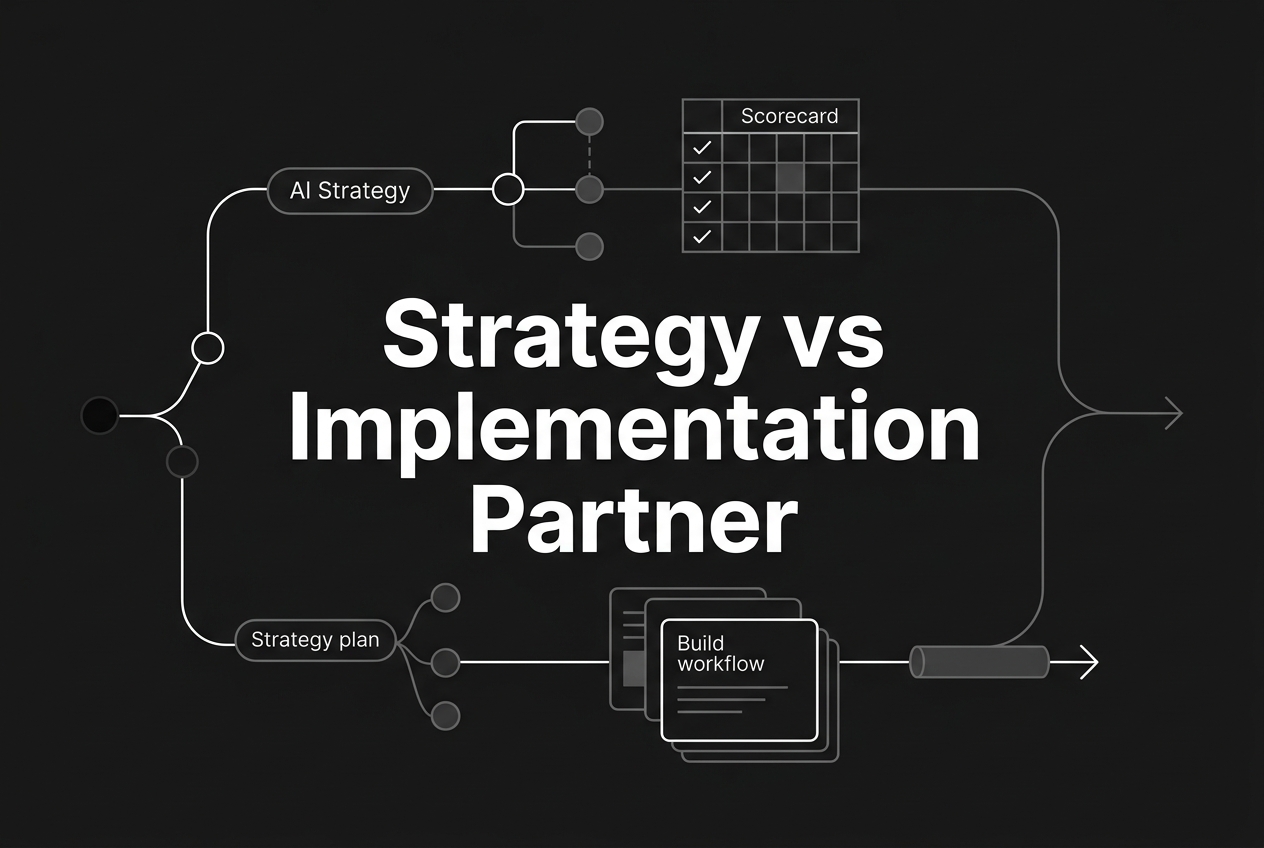
If you’re trying to decide between AI strategy, an AI consultancy, or an implementation partner, the hard part is not finding a vendor. It’s knowing what problem you actually need solved. For a growing SME, the right choice depends on whether you need direction, a working workflow, or both.
Start with the workflow that’s costing you time and margin. The rest gets easier once that’s clear.
1) Write the business problem in operational terms
Don’t start with AI. Start with the bottleneck.
Write down the exact process that’s causing pain, who touches it, what systems it moves through, how often it happens, and what goes wrong. If the issue is PDF invoices being keyed into accounting software, say that. If website leads are sitting too long before they reach a salesperson, say that. If support messages are lost in a shared inbox, say that.
A useful problem statement names:
- the process owner;
- the current steps;
- the manual work or rework;
- the business cost, such as missed follow-ups, errors, delays, or payroll waste;
- the outcome you want.
Done means: you can describe the problem in one page without saying “we need AI” as the answer.
Common mistake: trying to automate a symptom before you’ve named the real process. If every client follows a different path, you may need to standardize the process first.
Pro tip: If the process can’t be described clearly, it’s usually not ready for full automation yet. That’s a useful answer, not a failure.
2) Map the current workflow and systems
Once the problem is written down, map how the work actually flows today.
Talk to the people doing it. Observe a sample. Trace the path from trigger to outcome, including approvals, handoffs, spreadsheets, inboxes, PDFs, and any failure paths. Then list the systems involved, such as CRM, accounting, project management, HR, email, storage, APIs, and authentication.
For invoice work, that might include intake, document classification, supplier matching, field extraction, tax and total checks, duplicate detection, approval, accounting entry, and exception routing. For lead handling, it might include capture, qualification, deduplication, assignment, task creation, notification, follow-up, and escalation.
This is where many buyers overestimate their setup. Two tools saying they integrate is not the same as a working connection. You need to know what data can move, what permissions exist, what the API allows, and what happens when the write-back fails.
Done means: you know the system of record, the data owner, the process owner, every handoff, every exception, and the integration method or unknown at each step.
Common mistake: assuming the software stack is ready because the vendor says it has integrations. That’s a discovery problem, not a build problem.
3) Score readiness across people, process, technology, and data
This is where AI strategy becomes useful. Not as theory, but as a readiness check.
Look at four areas:
- People: Who owns the workflow? Who tests it? Who supports it after launch?
- Process: Is the work repeatable? Are rules and exceptions documented?
- Technology: Are the core systems accessible, with the right permissions and security controls?
- Data: Is the input current, complete, consistent, and available enough to use?
Then ask the risk question. If the output is wrong, is that a minor annoyance or something that affects money, customers, employees, privacy, or compliance? Does a human need to approve the action before anything external happens?
This is where a weak process or poor data can change the answer. If readiness is low across several areas, a broader AI consultancy engagement may be more useful than jumping straight to build work. If the process is stable and the systems are reachable, implementation can come first.
Done means: you have a red, amber, green view of the gaps and know which ones must be fixed before work can start.
Common mistake: saying “we have lots of data” when the real issue is that the data is duplicated, messy, or locked away.
4) Rank the candidate use cases by value, feasibility, and risk
Now make the choice concrete.
Create a short list of possible workflows and score each one on:
- business value,
- volume and frequency,
- feasibility,
- risk,
- adoption,
- time to evidence.
A good first use case is usually narrow, frequent, measurable, reversible, and tied to systems you already use. That’s why invoice extraction with human review, CRM lead routing, support ticket triage, and HR onboarding administration are often better starting points than a flashy chatbot.
The goal is not to pick the most impressive idea. It’s to pick the most tractable one.
Done means: the top use case has a named owner, baseline, target, data and integration inventory, risk view, pilot boundary, and a clear reason it outranks the others.
Common mistake: choosing the idea that sounds most advanced instead of the workflow that will actually move the business.
5) Decide whether you need strategy, implementation, or both
This is the decision point most buyers are really looking for.
Here’s the short version:
| Buyer condition | Best-fit engagement | Why |
|---|---|---|
| Several departments want different AI ideas | Strategy first | It creates prioritization, sequencing, and readiness |
| One repetitive workflow is painful and well understood | Implementation first | You need a working result, not a portfolio plan |
| The process changes by person or isn’t documented | Strategy/discovery first, then implementation | Standardization has to come before automation |
| Systems, data, or permissions are fragmented | Both or strategy-led implementation | The plan has to include integration and readiness work |
| You don’t have technical delivery capacity | Implementation partner, maybe after a short strategy sprint | Someone has to build, test, train, and support |
| You need governance, a portfolio view, or an operating model | Strategy first | One workflow build won’t answer the bigger question |
| You already have a roadmap, but nothing is live | Implementation partner | The gap is execution and adoption |
| The workflow affects money, employees, customers, or sensitive data | Both with explicit governance | You need risk design, testing, and escalation |
If this feels like a lot, use one filter: do you need decisions, or do you need a live workflow?
Done means: you can say, in plain language, whether you need strategy first, delivery first, or a combined engagement.
Common mistake: treating the label on the provider as the answer. “AI consultancy,” “implementation partner,” and “systems integrator” are often used loosely. The deliverables matter more than the title.
6) Specify the engagement and acceptance criteria
This is where vague projects go wrong.
For an AI consultancy engagement, ask for:
- business objectives and success measures;
- current-state process and system assessment;
- prioritized use-case list with scoring;
- readiness and risk findings;
- build, buy, or integrate recommendation;
- target-state design at the right level of detail;
- roadmap, milestones, dependencies, owners, and budget assumptions;
- a pilot brief with data, users, controls, and acceptance measures;
- a clear handoff or implementation path.
For an implementation partner, ask for:
- approved future-state workflow;
- source and destination systems and field mapping;
- integration and authentication plan;
- representative test data and edge cases;
- testing across function, integration, security, and user acceptance;
- measurable acceptance criteria before build starts;
- human review and exception rules;
- deployment, rollback, monitoring, and incident route;
- training, documentation, dashboard, and support terms.
If the provider can’t say what’s in scope, what’s out of scope, what you must provide, and what happens after go-live, the project isn’t ready.
Done means: you have a scope that names deliverables, acceptance criteria, and post-launch ownership.
Common mistake: signing a broad “AI implementation” statement of work that names a platform but not the workflow, fields, edge cases, or support model.
7) Pilot, measure, launch, and operate
A demo is not proof. A pilot is.
Before you change anything, record the baseline. Measure volume, cycle time, labor time, loaded labor cost assumption, error or rework rate, backlog, missed handoffs, service level, and business impact. Then compare the pilot against that baseline using real but controlled inputs.
Test the normal cases and the messy ones too. Include incomplete inputs, duplicates, permission failures, API outages, ambiguous language, and unsafe or high-impact requests. Decide who reviews exceptions, how fast they review them, where corrections are recorded, and when the workflow stops safely.
Before launch, make sure you have user acceptance, access and security review, retention decisions, monitoring, alert ownership, rollback or manual fallback, and a support route.
After launch, review quality, safety, latency, cost, exception rate, adoption, and the business KPI. Not just whether the automation ran.
Done means: the pilot meets the acceptance criteria, users can operate it, exceptions have owners, monitoring works, and you can compare actual results with the baseline.
Common mistake: calling a clean demo a success. Production is where permissions, edge cases, and human behavior show up.
What to look for in a provider
Once you know whether you need strategy, implementation, or both, judge providers by what they can actually do.
Discovery quality
A strong provider asks about outcomes, process steps, volume, exceptions, systems, data, users, risk, and post-launch ownership before recommending a model or tool. It should also be willing to say when a non-AI process change, conventional automation, or a built-in software feature is the better answer.
Delivery evidence
Ask for anonymized examples of similar workflow outcomes, not just demos of the model. Find out who will do the work, who leads the project, and how they handle testing. A nice slide deck doesn’t tell you whether the workflow will survive contact with your actual systems.
Commercial clarity
There’s no universal market price here, and you shouldn’t accept a made-up range. Ask for a breakdown of discovery, design, build or configuration, third-party licenses or usage, integration, testing, training, support, change requests, and ongoing monitoring. Also ask whether the work is fixed fee or time and materials, and who owns the custom work.
Integration and ownership
You need a system inventory, a data-flow diagram, an access plan, logging, error handling, and a responsibility matrix. You should also know who owns the accounts, prompts or configuration, code, workflow definitions, documentation, data, evaluation sets, and dashboards.
Security, privacy, and governance
Ask where data is processed and stored, whether it trains the provider’s models, how retention and deletion work, what sub-processors are involved, and how incidents are handled. Keep governance proportionate to the risk. A low-risk email workflow does not need the same controls as an automated accounting posting, but both need an owner and a failure route.
What this means for Rocket Boost AI
If you already see a concrete operational bottleneck, such as invoice processing, lead follow-up, support triage, HR onboarding, or cross-system data entry, a service like Automation Workflow Design and Implementation may be a fit.
It’s built to analyze manual processes, source and integrate third-party AI solutions, develop bespoke workflows when needed, connect systems across CRM, finance, HR, and project tools, and provide user onboarding and documentation. That makes it relevant when you need analysis, build work, and ongoing manageability in one engagement.
That said, the right first step is still the same: define the workflow, baseline it, score readiness and risk, and decide whether you need strategy, delivery, or both. That’s the part worth doing before you buy anything.
FAQ
Do I need AI strategy before automating one workflow?
Not always. If the workflow is painful, bounded, repeatable, measurable, and low risk, start with a focused discovery and pilot. Choose strategy first when priorities compete, readiness is weak, or the decision affects a broader operating model.
What does an AI consultancy actually deliver?
A useful AI consultancy delivers decisions and a plan: objectives, process and readiness assessment, prioritized use cases, build, buy, or integrate recommendations, risk and governance requirements, a business case, a roadmap, owners, and a delivery-ready pilot brief.
What does an implementation partner do that a consultant doesn’t?
An implementation partner is responsible for making the selected workflow work in your environment. That includes configuration or development, integrations, data mapping, testing, deployment, training, documentation, monitoring, exception handling, and support. Some firms do both, so check the scope, not the label.
How can I tell whether the automation will pay for itself?
Measure the current process first. Track volume, time, labor cost, errors, rework, delays, missed work, and business impact. Then compare the pilot against the baseline. Released hours only become cash savings if you actually avoid hiring, overtime, contractors, or other costs.
Who maintains the workflow after launch?
The contract should name the owner for monitoring, credentials, integration changes, model or tool changes, exception review, incident response, documentation, and user support. If you don’t have internal technical capacity, ask for managed support or a clearly documented operating model.
Next step
Pick one workflow that hurts most, document it, baseline it, and score readiness and risk. Then request proposals that show the exact deliverables and acceptance criteria.
If you’re an owner with a concrete bottleneck and want help with workflow analysis and implementation, Rocket Boost AI can be a fit for that conversation.
written by
